...
A Level VS IB Diploma

A Levels vs IB Diploma

IB Diploma vs A-Levels: we explore the choices faced by students as they choose between the IB Diploma Programme or the A-Level Programme in the UK.

Posted: 6th April 2025


A Levels vs IB: which is better for future leaders?

In today’s ultra-competitive world, the choice between A Levels vs the IB Diploma isn’t just an academic one – it’s a decision that could shape your future in science, technology, engineering, maths (STEM) or business. Whether your child is aiming to launch the next tech unicorn, break barriers in biotech, or lead global innovation in finance, the right academic pathway matters.

This definitive guide breaks down the IB Diploma vs A Levels debate across the factors that matter most: subject choice, academic depth, co-curricular, grading systems, university outcomes, and how to prepare.

It’s designed to help globally ambitious families make a confident decision.

Westbourne named most innovative independent school in the UK

 1. Subject Choice & Study Hours: Breadth vs Precision

A Levels offer laser-focused specialism. Students typically select three to four subjects, diving deep into chosen areas like Maths, Chemistry, or Business Studies. Weekly study hours can range from 12–20 hours, plus independent study. It’s ideal for students with clear passions and strengths who want to fast-track mastery.

The IB Diploma, by contrast, requires six subjects across six disciplines, including Maths, Science, a Language, Humanities, and either the Arts, or a further humanities or science subject. Three subjects are studied at Higher Level (HL), three at Standard Level (SL), with around 240 hours of instruction for HL and 150 for SL. The IB demands balance, which prepares students to think across domains – a critical advantage in interdisciplinary STEM and business fields.

Which is the winner for STEM/Business? IB for interdisciplinary thinkers; A Levels for focused specialists.


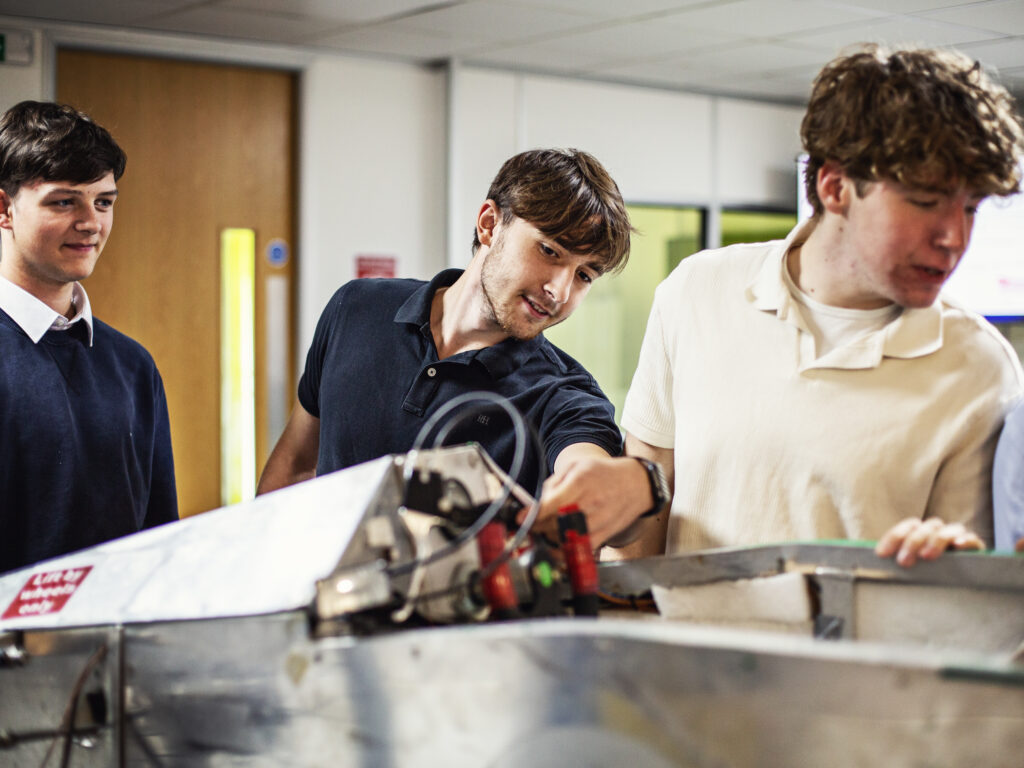
Greenpower electric racing car

2. Depth vs Focus: Mastery vs Agility

A Levels enable students to go deep, especially in core STEM subjects. For example, taking Maths, Further Maths, Physics and Chemistry creates a powerful academic profile for engineering or pure sciences. It’s focused, and with the right subject combo, it signals mastery to universities.

The IBDP, however, develops agile, conceptual thinkers. While you can take both Maths and Physics at HL, you’re also required to write an Extended Essay (up to 4,000 words) on a subject of your choice, and complete Theory of Knowledge (TOK), which teaches critical thinking across disciplines. STEM and business require not just knowledge, but perspective – and that’s where the IB shines.

Winner for STEM/Business? Depends on the goal. For technical depth, A Levels. For leadership, innovation and systems-thinking, the IB.

Westbourne launches A Levels for September 2025

3. Core vs Extras: Building More Than Just Grades

The IB’s Core – CAS (Creativity, Activity, Service), the Extended Essay, and TOK – is not “extra-curricular”. It’s essential. CAS challenges students to lead service projects, initiate clubs, or take part in outdoor pursuits. The Extended Essay builds academic stamina and verses students in how to write a university-style essay. TOK sharpens how students think about knowledge itself.

A Levels, on the other hand, don’t include a formal core. Students build their profile through voluntary enrichment – e.g., EPQ (Extended Project Qualification), leadership roles, competitions, or work experience. Schools vary in how structured this is. At a top school, this can be built-in; elsewhere, it may rely on student initiative.

Winner for STEM/Business? IB Diploma, for embedding skills beyond academics into the curriculum.

Westbourne named most innovative independent school in the UK

4. Grading: Simplicity vs Strategy

A Levels are graded A* to E, with A* seen as elite. Offers at top Russell Group universities are often based on achieving three A grades or higher. With a narrower focus, students can tailor effort to subjects they excel in. However, it means each grade carries significant weight.

IB scores range from 1 to 7 per subject, with up to 3 bonus points from the core (EE + TOK), for a maximum of 45 points. A score of 40+ is considered world-class. IB grading rewards consistency, self-management, and resilience.

Winner for STEM/Business? IB offers more granularity and rewards sustained excellence; A Levels offer clarity and subject-specific performance.

Announcing KnowVa Coach, our groundbreaking AI tutor

5. University Admissions: What Do Top Universities Prefer?

UK universities accept both pathways. For STEM, A Levels in Maths, Further Maths, and Sciences are often preferred for highly technical degrees. For business, a combination like Maths, Economics, and a humanity works well.

IB students, though, are increasingly valued for their breadth, research experience, and writing skills. Russell Group universities and Oxbridge welcome IBDP applicants, particularly those with HL subjects aligned to their course.

Internationally, the IB opens doors. It is accepted by top universities in the US, Canada, Australia, Singapore, Hong Kong, and Europe. In the US, high HL scores can earn college credit. The IB is also seen as excellent preparation for the liberal arts model.

Winner? IB for global flexibility; A Levels for UK-specific STEM routes.

future leaders lab

6. How to Prepare: The Student Profile That Thrives

A Levels require subject strength, time management, and exam focus. Students who know what they want and thrive under a structured syllabus do well. A strong school will supplement this with guidance and enrichment.

The IB requires more. Time management is critical, but so is curiosity. Students need to enjoy writing, thinking, debating, and working across disciplines. It’s a rigorous programme, but its graduates are often more independent, more rounded, and more confident.

Top Tip? Whichever you choose, success comes down to the right fit and the right school. Personal mentoring, academic stretch, and leadership development in STEM and business are all crucial for success.

Explore Westbourne Sixth Form succèss stories 

Westbourne launches A Levels for September 2025

Final Verdict: So, Which One?

There is no one-size-fits-all. But here’s a simplified scorecard for globally minded families:

Criteria A Levels IB Diploma
Subject Focus High High
Interdisciplinary Thinking Low High
Global Recognition Medium High
Research/Essay Skills Optional (EPQ) Core (EE, TOK)
University Flexibility Strong in UK Strong globally
Suits Technical STEM? Yes Yes (with HL choices)
Suits Future Leaders? Depends Yes

For future CEOs, innovators, or global change-makers in STEM and business, the IB Diploma offers not just knowledge but perspective. It builds leaders, not just learners.

That said, the A Level pathway remains elite – especially in the UK. The key? Choose the right school that pushes both academic results and character development, regardless of the qualification.

At Westbourne, we offer both. Our students go on to study PPE at Oxford, Maths at Cambridge, BioChem at MIT, Economics at LSE and Engineering at Imperial to name just a few.

Our approach? Academic rigour, leadership training, and global ambition – whether you choose IB or A Level.