

.png)
As a student, particularly if you are revising for those all important final exams, striking the right work-life balance can be tricky. For GCSE and IB Diploma students, the pressure of juggling school work, extra-curricular activities and maintaining an all-important social life is potentially overwhelming.
At Westbourne School, we pride ourselves on supporting our students to thrive academically, as well as offering them the tools and advice needed to balance their studies with their social lives. We have compiled a list of top tips that we think will help you (or your child) navigate a successful path through what is one of the most stressful periods of any young adult’s life.

1. Get organised
Tip number one is to buy yourself a diary, journal or calendar that you can use to visualise all of your exams, revision sessions and social commitments. Sometimes, visualising your workload can show you that there is actually much less to get done than you initially thought, and can spur you on to be super efficient!
Whether it be end of year exams, GCSE or IB Diploma study, planning and organisation are always top considerations.
.
2. Prioritise your dates
Once you have your major commitments recorded in the planner make time to go through it with a highlighter or coloured pen to plan and prioritise your goals, key dates and any special thoughts or notes you may want to add. We encourage all of our IB Sixth Form students to mark their IB Diploma exam dates as soon as they receive notification of them, as a matter of course. This feeds into the earlier organisation point!
3. Prioritise your topics
Prioritising can also be done on a more detailed scale. For each subject or exam, go through the syllabus and identify key topics. Run through the lists of these topics and highlight 3-5 topics that you think need the most attention. Jot down specific revision sessions for these topics in your planner.

4. Prioritise your time
Sometimes the sheer volume of work at the start of a study day can appear daunting and it can be easy to get distracted on smaller, less important tasks, rather than tackling the core topics. Research has shown that breaking down your time into 20 minute segments with a 5 minute break after each segment, can improve focus, maintain efficient working and reduce burnout.
For each 20 minute segment, be clear about the topic you are going to focus on, work hard for that 20 minutes, and then take a well-earned 5 minute break at the end. Use a timer to keep track of both the work segment and the breaks.
After 3 – 4 segments, take a longer 20 – 30 minute break, enjoy a short walk, have a shower, grab some food or call a friend – most students find themselves refreshed and ready to restart a new 3 x 20 minute study session if needbe.
%20(1).png)
5. Prioritise your sleep
Sleep is so important for you, your body and your mind. Scientists recommend that 14- 18 year olds should be getting between 8- 10 hours of sleep per night to optimise their brain function. It is not just the length of sleep, but the quality too.
Turn your phone off an hour before you go to bed to allow your mind to wind down, and you will probably find that sleeping comes a lot more easily. Doing relaxation activities in the evenings, such as mindfulness, breathing techniques or even yoga, can also promote a deeper sleep.
%20(2).png)
6. Fuel your body
When you’re spending what seems like endless hours at your desk, it’s hard not to snack on comfort foods! Don’t forget that your brain is the most powerful muscle in your body, and it is important to fuel your body correctly. One key nutrient that is excellent for improving mental health and wellbeing is Omega-3. Eating lots of fish, nuts and seeds will improve your intake of Omega-3 and you can find some tasty recipes too.
Scheduling three healthy meal times throughout the day can also help with organisation, and can break up the day to reduce the likelihood of burnout at GCSE, IB Diploma or A Level.
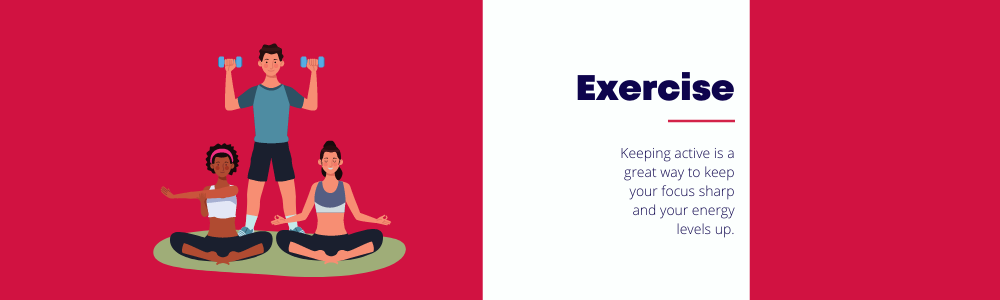
7. Exercise your body
When your exams are coming up, it can be difficult to factor in time for anything other than studying, but exercise is so important to your physical and mental wellbeing. Just 30 minutes of exercise a day can boost your energy, relax your body and mind and sharpen your focus.
Westbourne School Sixth Form students benefit from access to our local gym to improve their health and fitness, and there are many other first-class sports facilities in the Penarth and Cardiff area that they use regularly. We also offer a range of clubs and extra-curricular activities that students can enjoy as a break away from studies.

8. Talk to your family & friends
Often, students who spend a lot of time studying can find themselves feeling lonely and isolated. Remember that most of us have been through this at one time or another – you are not alone! Your peers are likely feeling some of the same stress and emotion that you are.
Why not pop downstairs for a cup of tea in the garden with your parents or FaceTime a friend to see how they’re getting on? You might make their day and make yourself feel a bit better too. If you’re a boarding student, head to the common room, or your boarding parent where you can speak with friends and relieve some of the stress you’re feeling.

9. It’s OK to ask for help
Whether it be from your family, friends, school or even someone who has been through the exams before, it is important that you ask for help where you need it.
Your teachers have helped you succeed at school for over a decade already, and they aren’t going to stop now. Visit your teacher’s office at lunchtime or after school and let them know where you are struggling, and they will often be able to sit down and find a solution to your problems.

10. Digital detox
Social media is designed to be addictive. Just checking your phone for a message or notification can often lead to spending significant amounts of time in front of a screen. Why not try putting your phone on charge in another room instead of next to you on the desk, or there are even some great apps for persuading you to take a break from social media.
And if you really can’t stay away from apps, then make sure they’re health-focused! A great one for managing stress levels is the Forest App. You can challenge your peers to see who can spend the most amount of time revising and off your phone – a fun and helpful way to stick to your revision plans. You can also check out our own App, Revoola, which we have introduced to all Westbourne School students to help monitor and improve their wellbeing.

11. Keep doing your hobbies
Making time for yourself is so important. Focusing on something you enjoy for just 30 minutes a day will boost your serotonin levels and give you an all-important energy boost to get your concentration levels up and your brain fully engaged!
Good Luck and Happy Studying!
We know that keeping your cool during this stressful time can be overwhelming, but we hope that these eleven simple tips might help you manage your time, responsibilities and mental strain a little bit better.
If you do ever find yourself overwhelmed at these stressful times and you need more support, Mind.org has provided a useful list of charities, helplines and websites that can provide more information on useful tips for dealing with stress.